I recently passed OffSec’s OSAI (AI-300) - ten years after I sat OSCP in 2016, another 24-hour OffSec exam. OSAI only went public a couple of months ago, but there are already plenty of write-ups on the course and exam itself. So rather than repeat what others have covered, I’ll focus on sharing something more my own: the harness architecture I built to get through it.
Building a Harness
In my opinion, OSAI is best approached after OSCP. OSCP covers Linux, Windows, web apps, APIs, and Active Directory penetration testing; OSAI layers on DevOps infrastructure, supply-chain attacks, development pipelines, and everything built on top of LLMs in recent years - RAG, MCP, agents, tool-use. It isn’t about the maths behind the models. It’s hands-on offensive testing against systems where traditional and AI technology sit side by side.
That breadth is why a harness architecture only works on top of real offensive security experience. It decides what to test and judges what comes back, but those calls rest on knowing what a genuine finding looks like and how an attack chain actually links together. Without OSCP-level knowledge or hands-on assessment experience, a human operator will struggle to judge or steer it and end up automating guesses at machine speed.
A 24-hour exam spanning mixed attack surfaces is a resource-allocation problem, and three things kill a single-agent approach:
- Context blowout. Hours of tool output fill the context window. The model drowns in its own history and makes worse decisions.
- No self-correction. A misclassified host or false proof propagates into every later decision. Errors compound silently.
- Rabbit holes. Agents are fast at finding and poor at knowing when to stop. Hours and tokens burned on a dead end can be the difference between pass and fail.
Three Planes
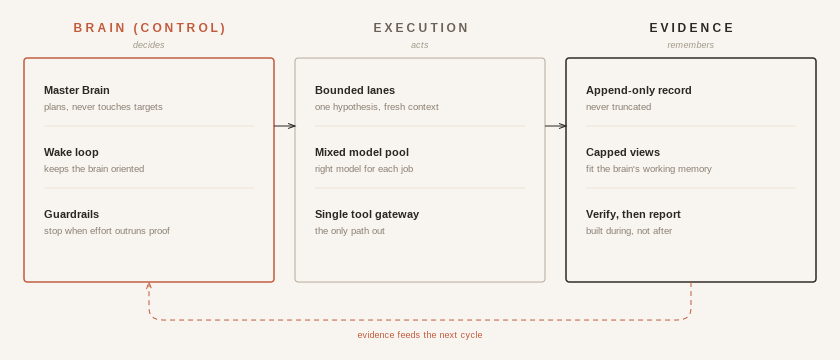
Control decides. Execution acts. Evidence remembers.
The planes differ mostly in how much context each one holds. The Master Brain never sees a port scan’s raw output. It sees “host X runs services A, B, C”, a finding the executor wrote before its context was thrown away. The brain is a long-running agent session that never touches a target, and it works in a six-step cycle:
- Read - wake loop delivers a delta of what changed
- Map - rebuild the picture: hosts, credentials, open theories
- Choose - admit hypotheses, assign lanes
- Test - executor runs the smallest signal-producing action
- Prove - verify before promoting any claim
- Record - update the evidence record, regenerate views
For a few reasons, I didn’t reach for the latest or most powerful models. The stack was a mix of early-2026 frontier models and open LLMs like DeepSeek Flash, with herdr handling the orchestration. The structure did more of the work than any single model.
The Report
The harness logged findings as it went, but the exam wants more: the command, its output, and a screenshot to prove it. Most of my work was in tmux on Kali, and the auto-capture was better at grabbing the orchestrator panel than the console at the moment that mattered - so the text evidence was solid, but the visual evidence I rebuilt by hand.
The subtler trap is that small errors pile up quietly - a decoy marked as exploited, a flag credited to the wrong host - and nothing catches them but a human asking whether the evidence actually holds. So build the report as you go, and check the agents’ work yourself before the clock runs out.
What’s Next
Nobody knows where cyber security will be in a year, offensive testing and risk assessment in particular, and I’d be wary of anyone who says they do. Scope, tooling and reporting are all moving at once.
If a well-built harness, even without the newest models, can cover a week of testing in a day, I don’t want to spend the saving on a bigger report delivered sooner. A client buried in findings is not a safer client. I’d rather use that time sitting with their engineers, product owners and CISO, showing them how their systems actually break, and agreeing what to fix first given their budget, their people and what the business can live with.
For those of us who advise on security, the role is shifting fast. AI has already sped up how quickly new CVEs land, and running one-off risk assessments matters less than it used to. What matters more is the continuous, human side of the work:
- helping filter out which risks can actually be chained into an attack
- helping turn critical ones into concrete engineering work the business can act on
Related: For a look at automating the purple teaming loop with CI/CD and AI, see Continuous Purple Teaming with CI/CD, IaC, and AI.